Congratulations to our awardees!

Reinier Hernandez

Josef Zahner

Wesley Armstrong
Abstract Submission Information for the 2024 PSMA Conference
| Name of Submitter | Institution | Title of Abstract |
| Adam Weiner, MD | University of California, Los Angeles | Correlating prostate-membrane antigen with molecular pathways in treatment naïve prostate cancer |
| Adrien Holzgreve, MD, MHBA | Ludwig-Maximilians-University of Munich | Randomized phase 2 trial of flexible and extended dosing of 177Lu-PSMA-617 1 molecular radioligand therapy (FLEX-MRT): Study Protocol |
| Alireza Ghodsi, MD | University of Washington | Validation of a Nomogram for Overall Survival in Patients Receiving 177Lu-PSMA-617 and Proposed Modification to Incorporate Tumor Volumetric Data |
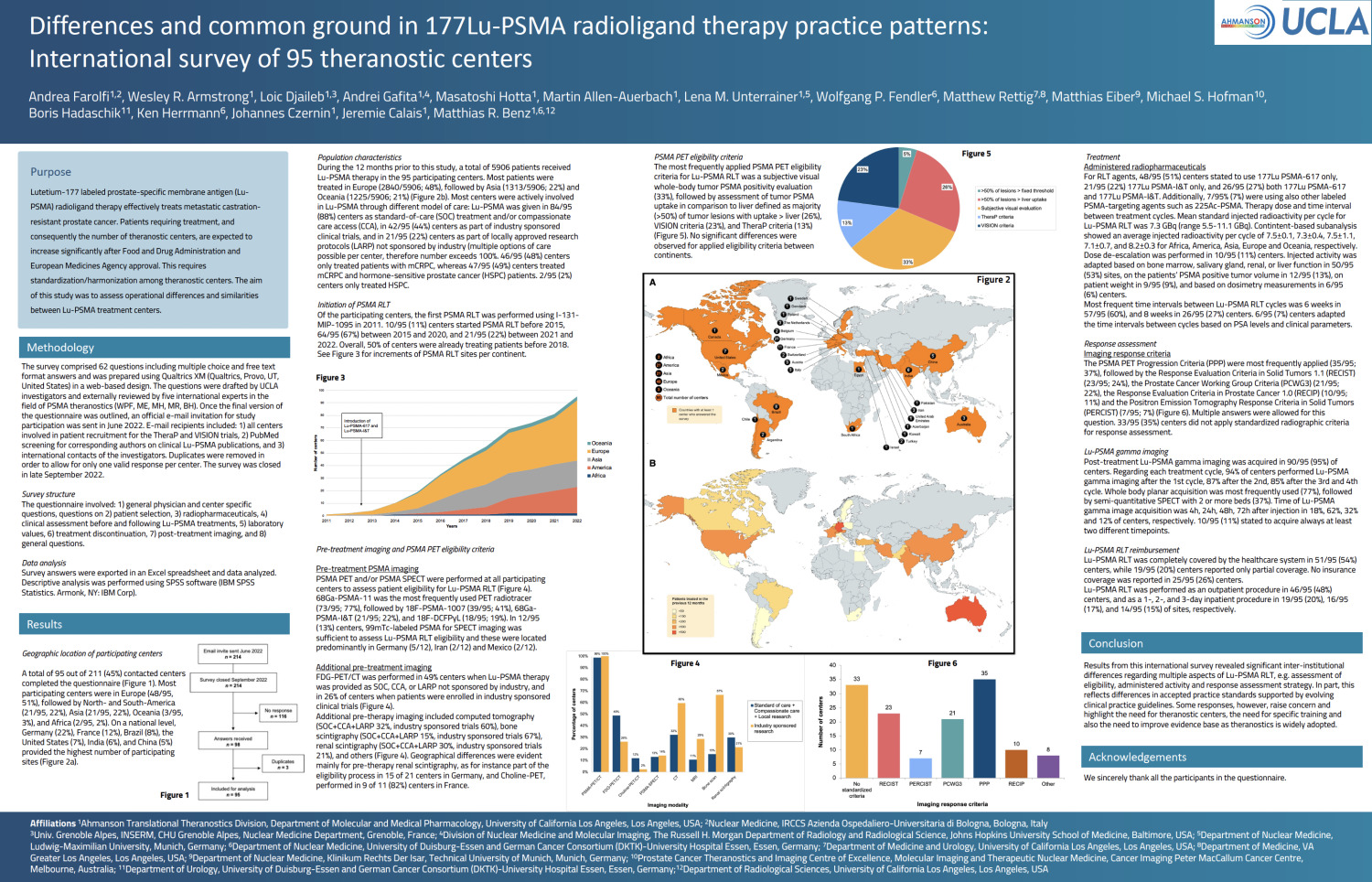
| Andrea Farolfi, MD | University of California, Los Angeles IRCCS Azienda Ospedaliero-Universitaria di Bologna | Differences and common ground in 177Lu-PSMA radioligand therapy practice patterns: International survey of 95 theranostic centers |
| Angela Castellanos Rieger, MD, MSc | University of California, Los Angeles | PSMA PET prognostic value for outcome of pre-chemotherapy post-ARSI CRPC patients after treatment: a single center retrospective analysis |
| Anil Bidkar, PhD | University of California, San Francisco | CD46: A Complementary and Alternative Biomarker to PSMA in Prostate Cancer Theranostics |
| Anju Wadhwa, PhD | University of California, San Francisco | PSMA-Targeted StarPEG Nanocarrier for Imaging and Therapy of Prostate Cancer |
| Benjamin Nicaise, MSc | Institut Curie | Radiomics Based Prediction of Non Responders to Stereotactic Body Radiation Therapy (SBRT) in Oligometastatic Prostate Cancer Using 68Ga PSMA 11 PET CT : A Retrospective Multicentric Study |
| Burcak Yilmaz, MD | Oregon Health & Science University | Using artificial intelligence with PSMA PET/CT to predict biochemical response after Lu-177 PSMA Therapy in Metastatic Castration Resistant Prostate Cancer Patients |
| Catherine Meyer, PhD | Oregon Health & Science University | Leveraging serial quantitative imaging for treatment response monitoring and dosimetry of 177Lu-PSMA-617 therapy |
| Catherine Meyer, PhD | Oregon Health & Science University | Tandem isotope therapy with 225Ac- and 177Lu-PSMA-617 in a murine model of prostate cancer |
| Celeste Winters, PhD, DABR | Oregon Health & Science University | Demystifying NRC Release Criteria for Lu-177 PSMA Therapy Patients |
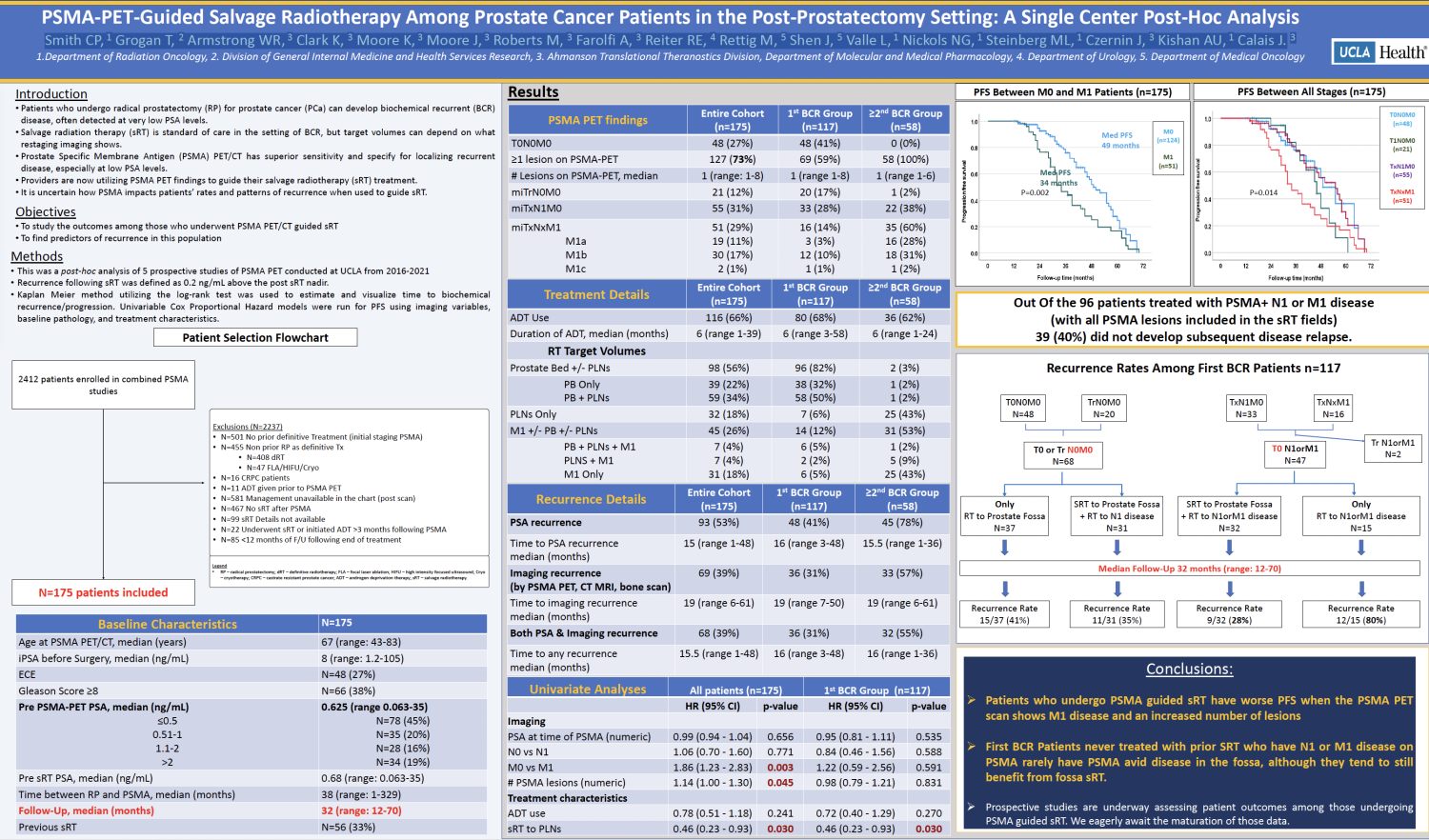
| Clayton Smith, MD | University of California, Los Angeles | PSMA PET Guided Salvage Radiotherapy Among Prostate Cancer Patients in the Post-Prostatectomy Setting: A Single Center Post-Hoc Analysis |
| Dimitrios Priftakis, MD | University College London Hospital | Interpretation performance of PROMISE classification system for indeterminate bone uptake on PSMA PET/CT during prostate cancer staging |
| Ida Sonni, MD | University of California, Los Angeles | Aggressive prostate cancer features on whole-mount histopathology and quantitative measures on PSMA PET |
| Ida Sonni, MD | University of California, Los Angeles | PSMA PET/CT and mpMRI discrepancies in prostate cancer detection with whole-mount histopathology gold standard |
| Jan Heilinger, MD | University of Cologne | Threshold for defining PSMA positivity prior to PSMA directed radioligand therapy: A comparison of [68Ga]Ga PSMA 11 and [18F]F-DCFPyL |
| John Nikitas, MD | University of California, Los Angeles | Update from the PSMA-dRT trial: A randomized phase III trial of PSMA-PET prior to definitive radiation therapy for unfavorable intermediate-risk or high-risk prostate cancer |
| John Nikitas, MD | University of California, Los Angeles | Metastasis-Directed Radiotherapy for Oligometastatic Castration-Resistant Prostate Cancer |
| Josef Zahner | Ludwig-Maximilians-University of Munich | Impacts of androgen receptor signaling inhibitors on absorbed doses in mCRPC patients undergoing 177Lu-PSMA-617 therapy: Preliminary dosimetry results |
| Kondapa Naidu Bobba, PhD | University of California, San Francisco | Development of 134Ce-PSMA-617 as a novel theranostic pair for 225Ac radiotherapeutics |
| Lena Unterrainer, MD | Ludwig-Maximilians-University of Munich University of California, Los Angeles | Low- and high-volume disease in mHSPC, from CHAARTED to PSMA-PET: an international multicenter retrospective study |
| Linlin Li, PhD, Hank Kung, PhD | Peking Union Medical College University of Pennsylvania | First in human study of [ 177 Lu] Lu P17 087 and [ 177 Lu] Lu P17 088 in patients with metastatic castration resistant prostate cancer: Comparison of Biodistribution and Dosimetry with [ 177 Lu]Lu PSMA 617 |
| Ruiyue Zhao, Hank Kung, PhD | Guangzhou Medical University University of Pennsylvania | First in human study of PSMA targeting agent, [ 18 F]AlF P16 093: Dosimetry and initial evaluation in prostate cancer patients |
| Loïc Djaileb, MD, PhD | Grenoble Alpes University University of California, Los Angeles | Pre-surgical 68Ga-PSMA-11 PET for biochemical recurrence risk assessment: a surrogate of Pelvic Lymph Node Dissection? Follow-up analysis of a Multicenter Prospective Phase 3 Imaging Trial |
| Luca Valle, MD | University of California, Los Angeles | Radiographic-Pathologic Concordance in the Workup of Locally Radiorecurrent Prostate Cancer |
| Mahbod Jafarvand, MD | University of California, Los Angeles | PSMA PET/CT for patients with prostate cancer after focal therapy; a single center retrospective analysis |
| Mariko Nakayama, MD | University of California, Los Angeles | Detection rate and impact on clinical management for [68Ga]Ga-PSMA-11 PET/CT in patients with very low serum PSA levels: a single-center, retrospective analysis |
| Masatoshi Hotta, MD | University of California, Los Angeles National Center for Global Health and Medicine, Tokyo | Kinetics of PSMA PET Signal After Radiotherapy in Prostate Cancer Lesions: A Single Center Retrospective Study |
| Pan Thin | University of California, Los Angeles | When to Repeat a PSMA PET after a Negative Scan in Patients with Recurrent Prostate Cancer under Observation: A Single-Center Retrospective Study |
| Reinier Hernandez, PhD | University of Wisconsin-Madison | Development of a long-acng PSMA radioligand for targeted alpha therapy of CRPC |
| Sungmin Woo, MD, PhD | New York University | Equivocal bone lesions on PSMA PET/CT: How common are they and how often are they metastases? A systematic review and meta-analysis |
| Surekha Yadav, MD | University of California, San Francisco | Lesion-based Response to PSMA Radioligand Therapy: Impact of Absorbed Dose |
| Vishnu Murthy | University of California, Los Angeles | Exploring the Generalizability of the Prognostic Value of Machine Learning Models Trained on Mid- Treatment PSMA PET/CT to End-of-Treatment PSMA PET/CT in mCRPC Patients Treated with 177Lu- PSMA Radioligand Therapy Using the TRAQinform Profile: A Retrospective, Single-Center Analysis |
| Vishnu Murthy | University of California, Los Angeles | Efficacy and toxicity of 177Lu-PSMA-617 for metastatic castration-resistant prostate cancer in a real-world setting: Results from the U.S. Expanded Access Program and comparison with phase 3 VISION data |
| Wesley Armstrong | University of California, Los Angeles | Prostate cancer disease volume in an “EMBARK-like” cohort of patients with high-risk non-metastatic hormone-sensitive prostate cancer as assessed by PSMA PET: A single center post-hoc retrospective analysis |
| Wesley Armstrong | University of California, Los Angeles | Impact of PSMA PET/CT on prostate cancer salvage radiotherapy management: results from the prospective randomized phase 3 trial [PSMA SRT NCT03582774] |
| Zachary Ells | University of California, Los Angeles | Dosimetry of Lutetium-177 PSMA-targeted radiopharmaceutical therapies for prostate cancer patients: a comparative systematic review and meta-analysis |
| Zachary Ells | University of California, Los Angeles | 99mTc-PSMA-I&S radioguided pelvic lymph node dissection in patients with prostate cancer pelvic lymph node metastasis: preliminary results from a prospective exploratory study |